Venus Retrograde in Your 2026 Solar Return
Two rules that cannot both be right
If your birthday falls between 25 October and 2 November 2026, three things are true of Venus in your solar return at once. She is retrograde. She is hidden by the Sun, too close to it to be seen. And she is in Libra, her own sign.
Two old rules read that combination in opposite ways. Abu Ma’shar, the ninth-century Persian astrologer, calls retrograde motion the worst weakness Venus can have, above all when the Sun hides her. The older Hellenistic tradition has a rule known as the chariot: a planet hidden by the Sun in its own sign is not harmed by it. It rides in its chariot, carried rather than smothered. For those nine birthdays, one rule says Venus starts your year at her lowest, and the other says she is protected. Both cannot simply be right.
What we are arguing about
A solar return is the chart for the moment the Sun comes back to the exact degree it held when you were born. Astrologers read it as the chart of the year that starts on your birthday. More in Solar return charts explained.
Venus is retrograde from 3 October to 14 November 2026, so every birthday from 3 October to 13 November gets a solar return with Venus retrograde. The question underneath is broader: when does a retrograde Venus in your return say something about you, and when is it just the sky everyone shares?
Below, we say what is settled, what rests on one author, and what is our own reasoning.
Three ways to read Venus walking backwards
Venus is love, money, pleasure and what you value. A retrograde planet looks, from the Earth, as if it walks backwards through the zodiac. Astrologers read that in three ways.
The traditional reading says a retrograde planet is weakened. Its matters arrive late, or come back. The modern reading says the planet turns inward and gets more intense, not less. Joanne Wickenburg calls retrograde planets stronger, more “in your face”. The mythic reading comes from one author, Demetra George. She reads the retrograde as a descent and return, like the goddess Inanna going down into the underworld. The 2026 sky fits: on 24 October at 03:44 UT, at 0°45′ Scorpio, Venus passes between the Earth and the Sun and turns from evening star into morning star.
There is a catch. Traditional doctrine on a planet’s phase tends to favour Venus as the evening star, which she is from 3 to 24 October. The morning star that follows is read as more assertive. So “rebirth” is not simply good news. It is a change of tone.
Here every modern source agrees: a retrograde Venus in the return makes the year a review of love, relationships, values and money. The inner quality of a bond or a choice counts for more than its outer trappings, and repairing what exists works better than rushing into something new.
Two authors narrow it further. Only the retrogrades of Mercury, Venus and Mars are worth reading in a solar return at all; this comes from one author, Mary Fortier Shea. The house Venus falls in shows which part of your life is being re-valued, the values you hold on your birthday are not always the ones you hold at year end, and people from the past come back; this comes from one author, Joanne Wickenburg.
The collision, looked at closely
From 14 October to 2 November Venus is within 15° of the Sun, the line we use for “under the beams”; some astrologers use 17°. From roughly 19 to 28 October she is within 8°30′, which is called combust. Either way she cannot be seen.
Abu Ma’shar’s line, in Benjamin Dykes’s translation, covers all of 14 October to 2 November. The modern astrologer Jo Tracey agreed in 2011 that combustion is the greatest affliction a time lord can carry in a solar return.
The chariot changes the picture on 25 October, when Venus moves back into Libra. Every Hellenistic source agrees on the rule; Antiochus and Porphyry both state it. Before that, in Scorpio, she is in detriment, opposite her own Taurus. She has one thing going for her there: Dorotheus makes her the day ruler of the water signs, Scorpio among them, so for day births the chariot applies in part. For night births between 14 and 24 October nothing softens Abu Ma’shar’s reading. This is our own reasoning, no source joins these two ideas.
Then there is a third view, ours. A combust planet is, in plain geometry, sitting on the Sun, and in a solar return the Sun sits on your natal Sun’s degree. That makes her central to the chart, not absent from it. Abu Ma’shar’s own checklist reads “hidden in the rays” as showing hidden things. Put together, both rules hold: Venus is central to the year, but her themes stay out of sight at first and come into view after she clears the glare around 3 November. This is our own reasoning, no source joins these two ideas.
What tends to come back
Three separate ideas point at the past.
The first is what we call retrograde resonance. If you were born with Venus retrograde, a Venus retrograde in your return tends to read as something from the past coming back. This is our own reading, and the evidence for Venus specifically is thin.
The second comes from one author, Nick Dagan Best: Venus retrograde crossing your Ascendant marks a new chapter. In 2026 the backward loop covers 22°52′ Libra to 8°29′ Scorpio. Any natal point in that stretch is crossed three times: forward, back, and forward again.
The third is the eight-year cycle, which Whitney Hill and Alison Price both use. Venus makes five retrogrades in eight years, and a retrograde in the same signs comes round every eight years. The last two ran from 5 October 2018 (10°50′ Scorpio) to 16 November (25°15′ Libra), and from 8 October 2010 (13°14′ Scorpio) to 18 November (27°39′ Libra). Put your 2018 and 2010 solar returns next to this one: what was on the table then is a good first place to look.
Does this apply to you?
For most people a retrograde Venus is background, shared with six weeks of birthdays. It becomes personal when Venus already holds a job in your chart or your year. Every source agrees on the principle: a planet that runs one of your timing systems is switched on, and its condition counts for more. Austin Coppock adds that a retrograde hits harder when the planet is prominent at birth.
First the dates, in UT and Amsterdam time. The clocks go back on 25 October at 03:00.
| Date | What happens | Where Venus is |
|---|---|---|
| 3 Oct, 07:15 UT (09:15 CEST) | Venus stations retrograde | 8°29′ Scorpio |
| 14 Oct to 2 Nov | Within 15° of the Sun: under the beams, hidden by its light | Scorpio, then Libra |
| 19 to 28 Oct | Within 8°30′ of the Sun: combust | Scorpio, then Libra |
| 24 Oct, 03:44 UT (05:44 CEST) | Inferior conjunction: Venus passes between the Earth and the Sun, and the evening star becomes the morning star | 0°45′ Scorpio |
| 25 Oct, 09:10 UT (10:10 CET) | Venus moves back into Libra, her own sign | Libra |
| 14 Nov, 00:27 UT (01:27 CET) | Venus stations direct | 22°52′ Libra |
If your birthday falls right at a station, roughly 1 to 5 October or 12 to 16 November, Venus stands almost still in your return. Seven Stars Astrology and Georgia Stathis both treat stations as the most concentrated point, and Stathis says to check whether your return Venus turns during the year. In 2026 she turns direct on 14 November, within six weeks of every birthday in the window.
Six checks
Each check is a switch, on or off.
- Venus is your Lord of the Year. In annual profections each year of life activates one sign, counted from your rising sign, and that sign’s ruler runs your year. In a Taurus or Libra year Venus is your Lord of the Year, and she starts it retrograde. This is the strongest switch, and the two stations become the year’s turning points. Our settled reading is delay, not denial: what Venus promises still arrives, later or in a revised form. Chris Brennan says this of a Lord of the Year that is retrograde at birth; applying it to the solar return is our own reasoning, no source joins these two ideas. On a retrograde Venus as Lord of the Year in the return itself, nobody has written about this case among modern authors. The free annual profections calculator finds it.
- You are in a Venus firdaria. Firdaria is a medieval system that hands each planet a fixed run of years. Venus gets eight: from your 10th birthday to your 18th if you were born by day, with the Sun above the horizon; from your 49th to your 57th if you were born at night, or from your 54th to your 62nd in another medieval ordering. On a retrograde Venus inside a Venus firdaria, nobody has written about this case.
- Zodiacal releasing has you in a Taurus or Libra period. Zodiacal releasing divides a life into chapters, each run by a sign. A Taurus or Libra chapter lasts eight years, with Venus in charge of the background. On a retrograde chapter ruler in the return, nobody has written about this case either.
- Venus is dominant in your birth chart. Venus on an angle, within about 3° of your Sun, Moon, Ascendant or Midheaven, or ruling your rising or Sun sign, as she does for every Taurus or Libra. Libra Suns born about 3 to 22 October have the switch built in: Venus rules their Sun and is retrograde in their return. Venus is the benefic of the night, so she acts more kindly in a night chart; every source agrees that sect changes how gently she acts, not how loudly.
- Venus is on an angle, or on the Sun, Moon, Ascendant or Midheaven, in the return. Then she is loud whichever way she moves. The usual orb is about 3°. Birthdays from roughly 19 to 28 October are the disputed case. Venus is combust then, and the return Sun always sits on your natal Sun’s degree, so by our reading a combust Venus counts as Venus on the Sun. By a strict 3° rule only birthdays around 22 to 25 October qualify. The angles depend on where you spend your birthday.
- Your progressed Venus is stationing. Secondary progressions count each day after birth as a year of life, so if you were born N days before a Venus station, your progressed Venus turns at about age N.
These are the groups whose progressed Venus is standing still this year:
- Born around 25 August or around 6 October 1970: 55 or 56 now.
- Born around 14 April or around 27 May 1988: 38 this year.
- Born around 3 July or around 15 August 1999: 27 this year.
- Born around 8 July or around 20 August 2007: 19 this year.
A progressed planet near its station barely moves for years, so this is a long background, and your birth time moves the edges a little. Progressed Venus turning retrograde reads as a withdrawal from a lifelong attraction, where borrowed values fall away; this comes from one author, Erin Sullivan. On a progressed station in the same year as a retrograde Venus in the return, nobody has written about this case.
Count your switches
- 0: background colour.
- 1: noticeable. Venus matters get a second look.
- 2: a Venus year.
- 3 or more, including a time lord (the Lord of the Year, a firdaria or a releasing period): Venus is the story of the year.
The scale is our own shorthand.
A worked example
A fictional woman: Libra rising, born at night, turning 36 on 20 October 2026.
- At 36 the profection comes back to her 1st house, Libra. Venus is her Lord of the Year: switch one, and a time lord.
- Venus rules her Ascendant, and her Sun is in Libra too. Switch two.
- Her night Venus firdaria starts at 49 or 54. Not yet.
- In her return Venus is retrograde in Scorpio and combust, about 6.8° from the Sun. By the strict 3° rule that is too wide to count. By our reading of combust as sitting on the Sun, it is switch three.
So two switches for certain, three by our reading, and a time lord either way. Delay, not denial: something in love or money comes back to be settled properly rather than quickly. Her Lord of the Year starts the year hidden, clears the glare around 3 November and turns direct on 14 November, the likely turning point.
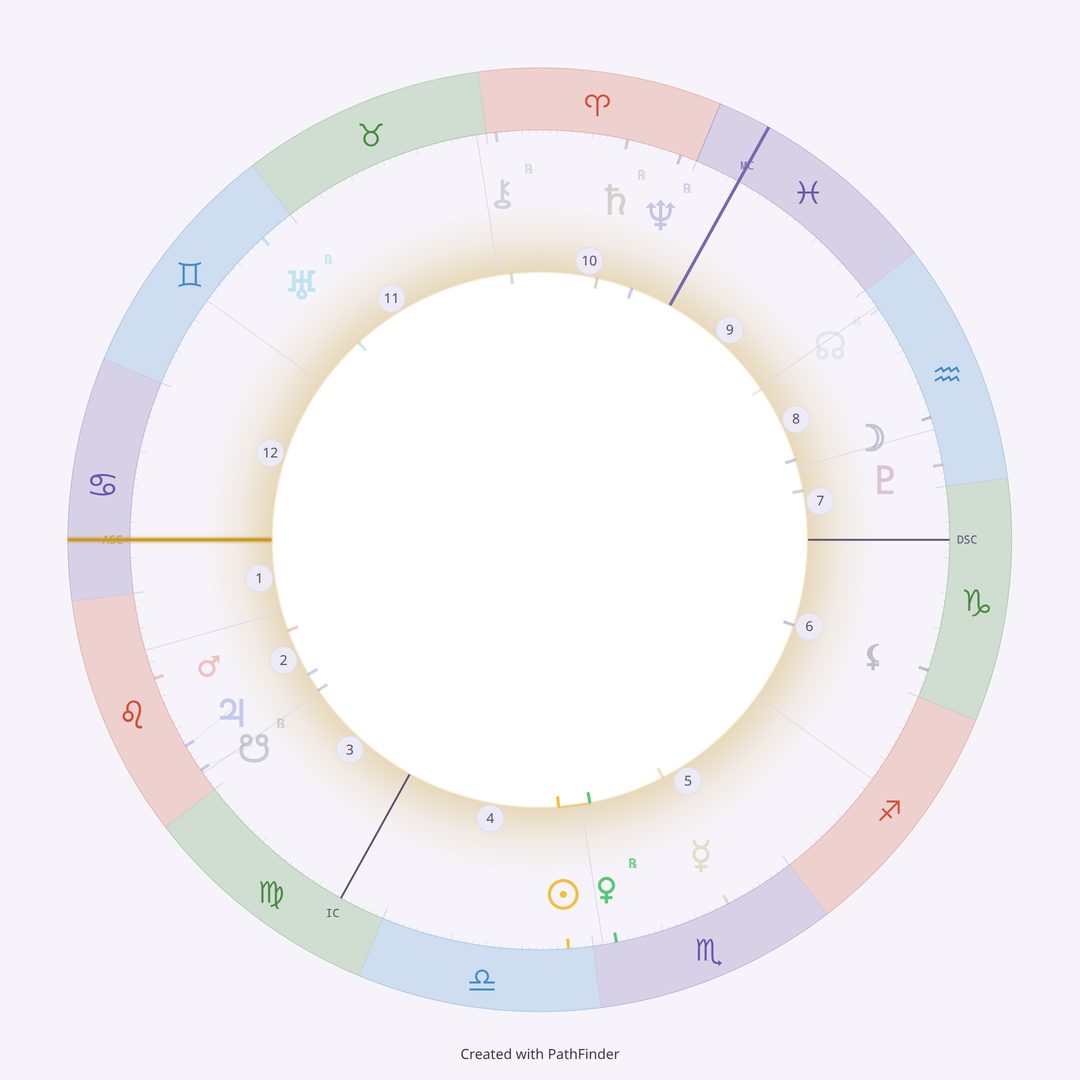
What PathFinder can and cannot check: it finds your Lord of the Year, casts your return for where you spend your birthday, runs zodiacal releasing and scores how much of your birth chart Venus runs. It does not compute firdaria or flag progressed stations, so checks 2 and 6 are by hand.
Our verdict
For birthdays from 14 to 24 October, in the Scorpio stretch, the harsher medieval reading fits better. Venus is retrograde, hidden and in her detriment, and for night births nothing in the tradition softens it. From 25 October to 2 November, back in Libra, the chariot fits: hidden, but at home and carried. Neither is a verdict on anyone’s love life. For most people neither reading matters unless a switch is on; without one, this retrograde is weather.
How many switches are on in your chart, and what did Venus bring back the last time she turned in this part of the sky?
Sources. Positions and times: Swiss Ephemeris via pyswisseph, tropical, geocentric, checked to the arcminute and the minute. The traditional reading follows Abu Ma’shar in Benjamin Dykes’s translations, and the chariot rule Antiochus, Porphyry and Dorotheus. The modern reading follows Mary Fortier Shea, Joanne Wickenburg, Georgia Stathis, Jo Tracey and Seven Stars Astrology. The mythic reading follows Demetra George, progressed Venus Erin Sullivan, and the eight-year cycle Whitney Hill and Alison Price. Profections and time lords follow Chris Brennan, Austin Coppock and Nick Dagan Best on The Astrology Podcast. The worked example is fictional. For self-reflection and educational purposes.