The Moon, The Nurturer: When the Moon Leads Your Chart
A Cancer Sun is not a Moon led chart. We checked.
We ran twenty one famous Cancer Suns through PathFinder, all with birth times rated AA or A. Exactly one of them came out as The Nurturer, the Moon’s archetype, with the Moon leading alone. One more came out as a pair, with the Sun and the Moon sharing the lead and the Sun in front. The other nineteen are led by something else.
Now take the two people in this article who are Moon led. One of them is that single Cancer. The other is a Scorpio.
This is the third article in our series on the Archetype of Realization, one planet at a time. Part one covered Saturn, The Elder. Part two covered Pluto, The Transformer. This one is about the Moon. The social posts for it go out on the New Moon in Scorpio of 9 November 2026, which is a posting date and nothing more.
What an Archetype of Realization is
PathFinder reads every chart through four points first: the Sun, the Moon, the Ascendant and the Midheaven. We call them the Four Primaries.
Each of the ten planets is scored on how strongly it ties into those four. Five signals count: an aspect to a Primary within ten degrees; ruling the sign a Primary sits in; essential dignity, meaning how comfortable the planet is in its sign; sitting in an angular house; and synergy, when one planet ties into more than one Primary.
The planet with the highest score is your dominant planet. It names your archetype. If the runner up is within ten percent, you get a pair instead.
The Primary your dominant planet connects to most strongly is its connection point. It changes how the archetype is lived. A separate label, Known For, names your most elevated planet. PathFinder counts it by sign: the planet nearest the start of the tenth sign from your rising sign. That one needs a birth time. Roughly: the archetype says what drives you, and Known For is what other people notice first.
The Moon is one of the four points itself. It still gets scored like every other planet, on how it ties into the Sun, the Ascendant and the Midheaven, and on its own sign and house. When that score comes out highest, the chart is The Nurturer. The principle in the app reads: Emotional responsiveness, instinct, and belonging.
Reflected light
The Moon has no light of its own. What we see at night is sunlight, returned. Astrologers have read that fact for a long time. Israel Ajose, on The Astrology Podcast, describes the Moon as the receiver and reflector of the Sun’s light: where the Sun is the conscious will, the Moon is the receptive, instinctive layer underneath it.
The oldest surviving textbook of the craft already reads it that way. Vettius Valens, writing in the second century, gives the Moon motherhood and nurturance, the body and its sensations, the people and the crowd, private affairs and hidden things, houses, property and roots (Anthologies, Mark Riley’s translation). The Moon is at home in Cancer and exalted in Taurus.
Modern psychological astrology kept the same ground and turned it inward. Howard Sasportas, writing with Liz Greene, noted that when the Moon dominates a chart, the life tends to revolve around home, family, roots and the inner emotional landscape (The Luminaries, 1992).
None of this is dramatic. The Moon is the part of astrology people wave away as soft, and then go home to.
How The Nurturer shows up
Start with the need, because the Moon is a need before it is a gift. The need is to feel safe, connected and emotionally held. To nurture, and to be nurtured. When the Moon leads, that need is the ground the rest of the chart stands on.
The gift grows out of it. You know what a room needs before anyone names it. You read feeling the way other people read words: deep empathy, emotional intelligence, protective instincts, strong intuition. You notice who is cold, who is hungry, who has gone quiet. People feel looked after around you, and often cannot say why.
There is a hard part. Care can tip into smothering, and being needed can become a way of staying. Mood can become the weather everyone else has to dress for. The past can feel safer than the present, because it is already known.
The way out uses the same instinct. The part of you that knows what everyone else needs can be turned around and asked what you need. Looking after yourself is the same skill, pointed home.
The Nurturer, through each of the four points
Where The Nurturer shows depends on the connection point, the Primary the Moon ties into most strongly.
The Ascendant is the coat you were born wearing: body, pace, the face at rest. Through the Ascendant, The Nurturer is a warmth people feel before you say a word. Strangers tell you things.
The Midheaven is the sentence people say about you when you are not in the room. In the app the label reads “Career and public role”. Through the Midheaven, the work itself looks after people, or the public life feels like family. Teaching, care, food, a band that is a household, an audience that is kept close.
The Sun is the voice you hear when you talk to yourself. Through the Sun, caring for others is the way you are most yourself. Nobody has to perform it. It is what being you looks like.
The Moon is felt in private and seen only in intimacy. Through the Moon, The Nurturer lives in a private world of feeling, shared with the closest few. Acquaintances may never see it. The people inside the circle would not recognise you without it.
Two charts where the Moon leads
Both charts below were computed on 24 October 2026 with PathFinder’s Public API, tropical zodiac, Placidus houses. Birth data come from Astro-Databank. In both the Moon leads alone, with no second planet sharing the lead. Both people are alive, so we keep to the public record of their work.
Joni Mitchell: The Nurturer through the Midheaven
Her Sun is in Scorpio, her Moon in Pisces, her Ascendant in Cancer. The Moon sits in the tenth house, right on the Midheaven, and squares Saturn in Gemini. The Moon also rules her Cancer Ascendant.
The connection point is the Midheaven. The Nurturer lives in her public role. Her Known For is the Moon as well: Empathy and Emotional Depth. Here the two layers sit in the same place, so what drives her and what people notice first are the same planet.
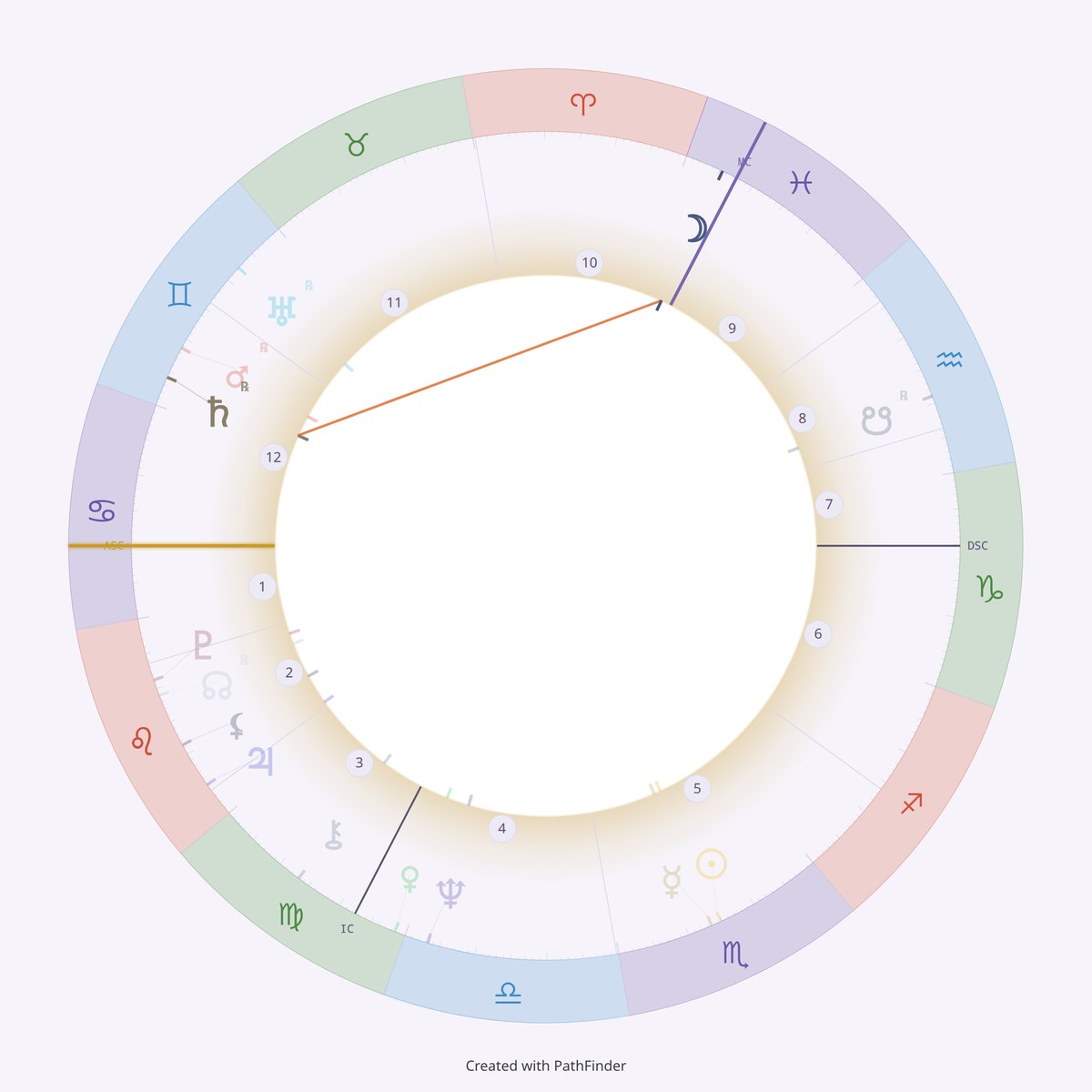
The public record fits. She taught herself the ukulele and then the guitar, and worked out her own tunings. She wrote her first song on the train to the Mariposa Folk Festival. Her albums put private feeling on the record, Blue above all. With the Moon on the Midheaven, the inner world became the public work.
Harrison Ford: The Nurturer through the Sun
His Sun is in Cancer, his Moon in Cancer, his Ascendant in Libra. The Moon sits beside the Sun in the tenth house, in its own sign. This is the one Cancer Sun of the twenty one whose chart came out as The Nurturer.
The connection point is the Sun. His Known For is Mercury: Quick Thinking and Communication. The Moon is close to the Midheaven, but Mercury is nearer the start of Cancer, his tenth sign, so Mercury gets the label.
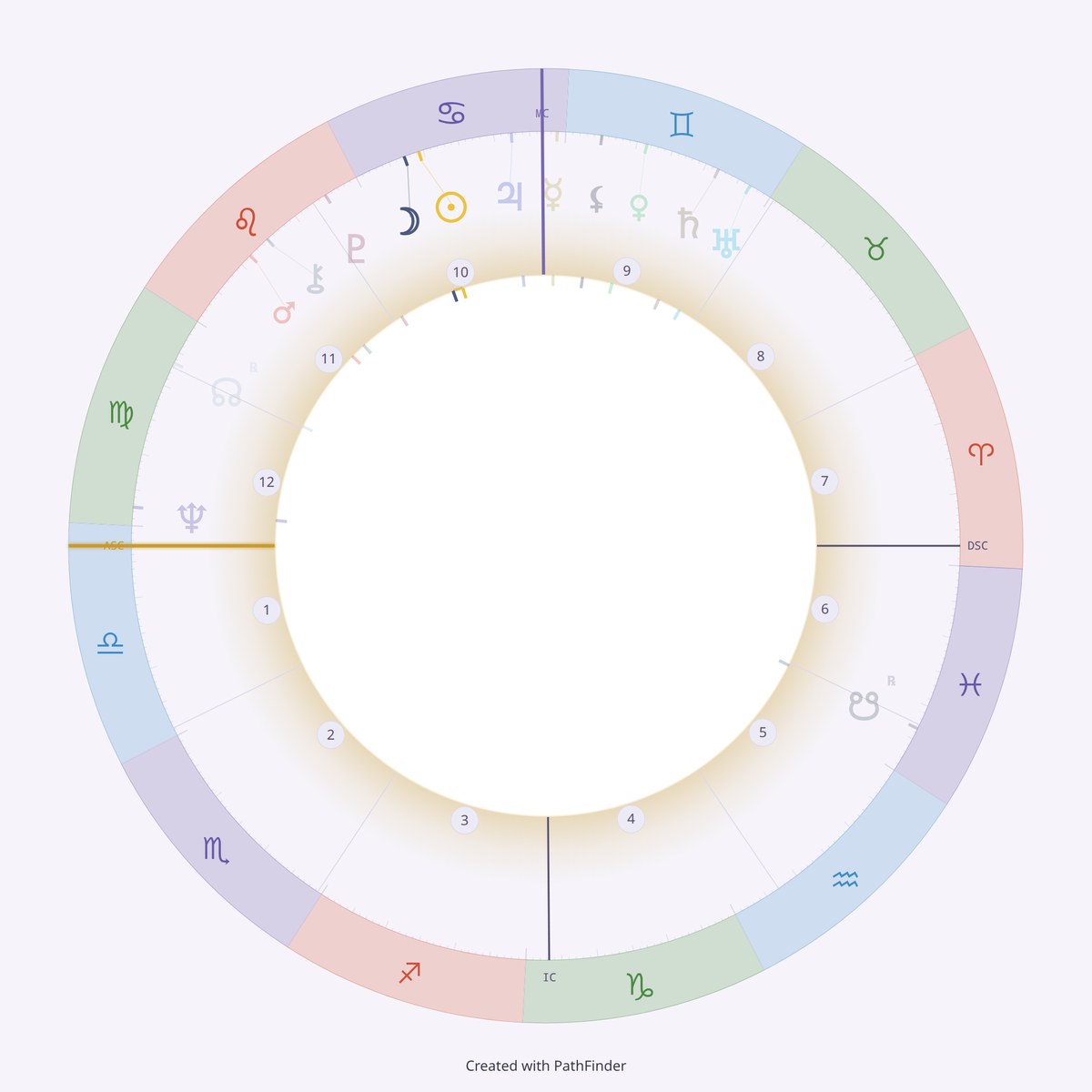
He was a carpenter before the films, building for other people with his hands. He is a licensed pilot who flies his own aircraft and has taken part in search and rescue flights for lost hikers. He has spent decades working with Conservation International. With the Moon beside the Sun, looking after things is how he is himself.
Known For Moon is not the same as The Nurturer
The Moon can be your most elevated planet without leading your chart. Known For answers one question: which planet sits nearest the start of your tenth sign. The archetype answers a different one: which planet ties into all four points most strongly.
Meryl Streep, from the Pluto article, is the clean example. Her Known For is the Moon, Empathy and Emotional Depth, and her archetype is The Transformer, with Pluto leading through the Moon. People notice the empathy first. Something else drives it.
Joni Mitchell shows the other case: Known For Moon and The Nurturer together. Harrison Ford shows a third: The Nurturer, with Mercury as Known For.
The Moon doesn’t always lead alone, either. When a second planet scores within ten percent of it, the chart gets a pair archetype. That is what happened to the other Cancer Sun in our set, with the Sun in front. Pairs get their own articles later in the series.
Looking at your own chart
In PathFinder, open your natal chart and find your Archetype of Realization. You’ll see the name, the connection point and, if your birth time is known, your Known For.
If the Moon leads, look at which of the four points it runs through. If the Moon is your Known For but not your archetype, ask what the empathy people see is in service of. If it is neither, look at where the Moon sits and what it touches. That is still where you go to feel safe.
Next in the series comes another planet and another archetype. Until then: who do you look after without being asked, and who looks after you?
For self-reflection and educational purposes. Astrology is not a substitute for professional advice.