Venus Retrograde in Scorpio 2026: The Hidden Passage and the Morning Star
Venus has been retrograde since 3 October, when she stood still at 8°29′ Scorpio. Since then she has been sliding backwards towards the Sun, and for the last few days nobody has been able to see her: she is too close to the Sun from anywhere on Earth. From the Netherlands she stays hidden until the start of November. This post is about that stretch: the part of the retrograde that happens out of sight, the meeting with the Sun on 24 October at 0°45′ Scorpio, and her return as the morning star. We read it for all of us together, as a shared mood and a pattern in public life, and through one of the oldest stories people told about it, the descent of Inanna.
If your birthday falls in these weeks, start with Venus Retrograde 2026 and Your Solar Return. This one starts from the sky itself.
The descent so far
For anyone watching from the Netherlands, Venus left the evening sky early. She sits far south of the Sun’s path, which lies almost flat on the autumn evening horizon, so from about 10 September she was too low to see. In this cycle the descent was long.
The astrological steps came later. On 14 October Venus came within 15° of the Sun, at 6°04′ Scorpio. By the common rule that is “under the beams”. On 18 October she came within 8°30′, at 3°55′ Scorpio, which the tradition calls combust, burned by the Sun. She stays combust until 29 October. Today, 20 October, she squares Pluto, both at 3°04′ of their signs, Scorpio and Aquarius, the exact degree where Pluto stood still and turned direct on 16 October. It is the second of three squares between them, after 15 September and before 9 December. In modern astrology Pluto stands for power and for what is kept out of sight, and a square is friction.
The old astrologers had a clear view of this condition. Abu Ma’shar, the ninth-century Persian astrologer, says a planet hidden in the Sun’s rays signifies hidden things. He also says that for Venus, being retrograde and hidden at the same time is her worst weakness.
Scorpio adds its own colour. It is the sign opposite her home, Taurus, and every traditional source calls it her detriment. The tradition gives Scorpio to Mars, and modern astrology adds Pluto as its ruler, which puts today’s square with Pluto inside Venus’s borrowed house. It is a fixed water sign, which the tradition reads as deep and slow. Chris Brennan and Skye Barclay, on The Astrology Podcast this month, read detriment as Venus still going after her usual goals with unfamiliar tools, and in Scorpio those tools belong to Mars: cutting, sharpness, separation, directness. The tradition also tied Scorpio to death and what lies beneath. So the planet the tradition gives to joining and pleasure is backwards, out of sight, and working in a borrowed house.
The story the old world told
The Sumerians called Venus Inanna, goddess of love and the fertility of the land, and also of battle. Demetra George, speaking with Chris Brennan on The Astrology Podcast, describes a long line of scholarship that ties Inanna’s best-known myth to this exact passage of the Venus cycle. The main modern text is Diane Wolkstein and Samuel Noah Kramer’s Inanna, Queen of Heaven and Earth (1983). It opens like this: “From the great heaven she set her mind on the great below.”
In George’s telling the map is close to literal. As the evening star sinks lower each night, Inanna passes through seven gates, and at each one she has to give up a symbol of power: her crown, her beads, her breastplate. The station retrograde is the moment she sets out. Disappearing into the Sun’s rays is entering the underworld. Brennan links that invisible stretch to themes of a “dark night of the soul”, the things people keep private. At the bottom her sister Ereshkigal, queen of the dead, fixes her with the eye of death, and Inanna hangs as a corpse on a hook. George places that moment at the conjunction itself. While she is below, the later Akkadian version adds, nothing on Earth grows or breeds. Then her servant Ninshubur goes for help, the god Enki sends the food and water of life, and she comes back.
What the hidden passage means for all of us
Brennan spent a whole episode going through a century of Venus retrogrades in Scorpio. Two threads keep returning in his history. The first is unearthing: things sealed away come back into view. He points to 1922 and to 1994, when a sealed cave full of palaeolithic paintings was found. The second is secrets coming out. He cites Iran–Contra in 1986 and the WikiLeaks diplomatic cables in 2010, and, in 1962, Rachel Carson’s exposure of the hidden effects of pesticides. That is one author’s pattern, drawn across decades. It does not forecast a given week.
George reads the invisible stretch inward, as a private reckoning over what we do not show. Abu Ma’shar, from the other end of the tradition, says hidden things. Our reading for the shared mood of these weeks builds on both. Questions about what our bonds rest on, and what we are willing to pay for them, are being settled below the surface, in rooms we do not see. In public life this is the kind of period when the hidden terms of an arrangement matter more than its pleasant face, and when something buried can surface. In our shared mood it can feel like pleasure has gone flat and charm has stopped working. That fits a Venus who has handed over her ornaments at the gates.
24 October: the meeting with the Sun
The Sun enters Scorpio on 23 October. The next morning, at 03:44 UT (05:44 in Amsterdam), Venus passes exactly between the Earth and the Sun in longitude, at 0°45′ Scorpio. She is at her closest to us in the whole cycle, 0.27 astronomical units away. She is also 6°31′ south of the Sun, so she passes well below its disc. There is nothing to see.
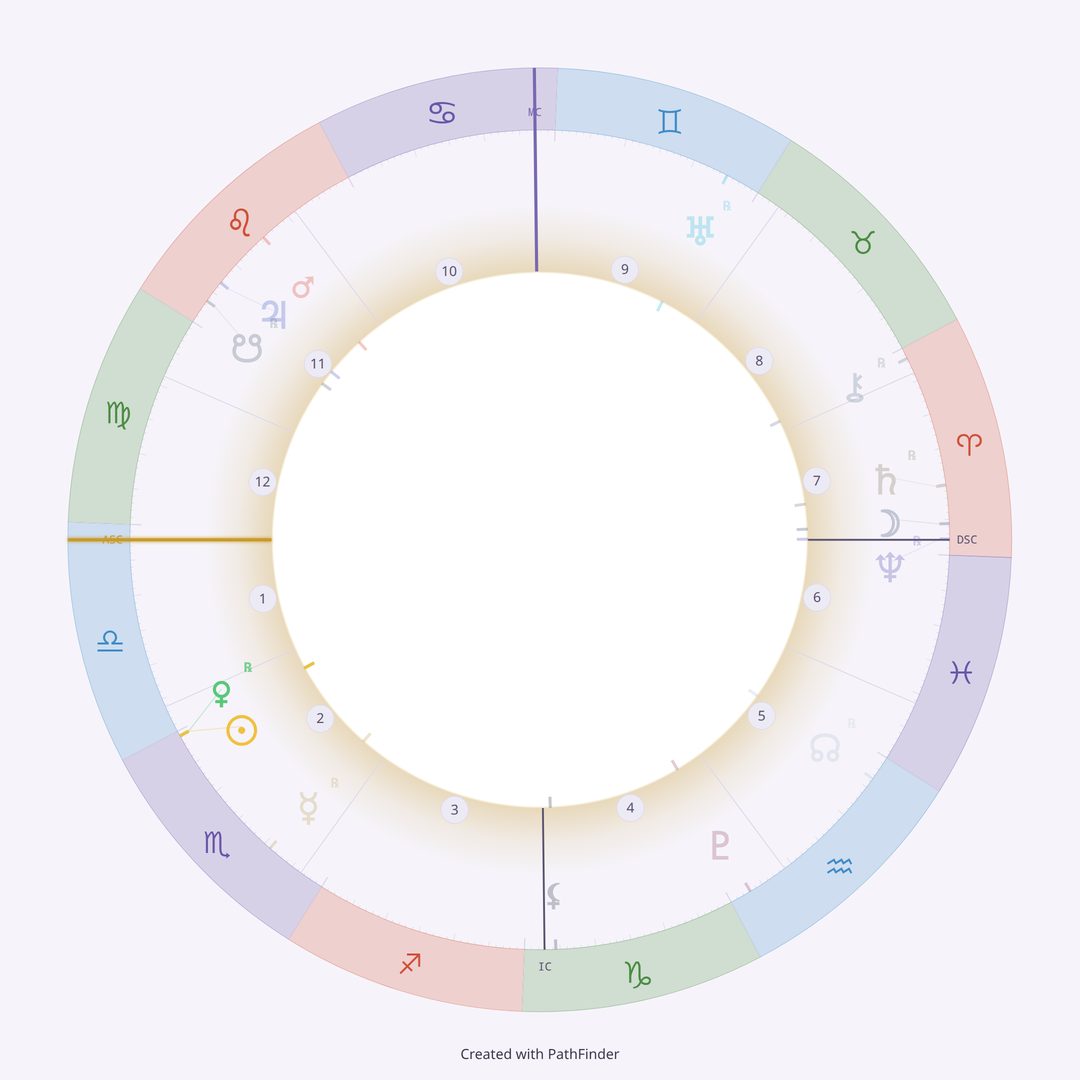
Many astrologers call this moment cazimi, a planet “in the heart of the Sun”. We use William Lilly’s rule from Christian Astrology (1647): a planet within 17′ of the Sun, before or after. By that rule Venus is cazimi from 23:31 UT on 23 October to 07:57 UT on 24 October, about eight and a half hours, or 01:31 to 09:57 Amsterdam time on the 24th. Some later authors add a stricter condition, that the planet must also be within a few minutes of the Sun in latitude. Venus is six and a half degrees south, so by that rule she is burned by the Sun and never reaches its heart.
The two old views collide here. Lilly writes that all authors hold a planet in cazimi to be fortified. Abu Ma’shar calls a retrograde Venus hidden by the Sun her worst weakness. Both are doctrine, and they point opposite ways. We sit between them. The thing at the centre of this retrograde happens out of sight and as close to the source of light as Venus ever gets. It is a turning point, and it is too early to call it a verdict. In the myth it is the hook: the lowest point, and also the point after which the only way is back.
Two more things happen that morning. At 07:13 UT Mercury stands still and turns retrograde at 20°59′ Scorpio, so the planet astrologers give to talk and contracts starts going back over things on the same morning Venus meets the Sun. The degree 0°45′ is the first in Scorpio, and it closes a family. Venus meets the Sun on her retrograde at almost the same point every eight years, slipping back about 2°20′ each time: 10°18′ Scorpio on 2 November 1994, 7°53′ on 31 October 2002, 5°30′ on 29 October 2010, 3°06′ on 26 October 2018, and now 0°45′. The next one, on 21 October 2034, falls at 28°22′ Libra. Brennan makes the same point: this is the last Scorpio meeting before a long run in Libra. We read it as a long chapter of Venus in this sign closing, collectively, with a meeting nobody can see.
Coming back as the morning star
On 25 October Venus slips back into Libra, her own sign. An old Hellenistic rule, stated by Antiochus and Porphyry, says a planet under the beams in its own sign is not harmed by them: it rides in its chariot, hidden but protected. On 26 October the Sun squares Pluto at 3°06′, in our reading a last push of friction. On 29 October Venus moves out of combustion.
Then she comes back into view. Our calculation for Rotterdam puts the first naked-eye sighting around 1 November, low in the east-southeast just before sunrise, weather and horizon permitting; a few days later further north. By 8 November she stands about 10° high thirty-five minutes before the Sun comes up. On the evening of 2 November she clears 15° from the Sun and is out from under the beams. On 4 November she makes a sextile to Jupiter at 24°44′ Libra and Leo, the first easy contact of the hidden passage and its aftermath. The same day the Sun meets Mercury at 12°11′ Scorpio, the middle of the Mercury retrograde.
George describes Inanna coming up battered, weak and reddish, and still alive. She gives that moment the sense of “I made it right. I survived.” The Sumerians knew the morning star as a different face of the goddess, the one who stood for battle and justice. George calls it the power of an autonomous person, power that nobody else props up, and links it to activism and to refusing to tolerate abuse.
The myth has one more scene, and it is the hardest. Inanna goes home and finds her husband Dumuzi sitting on her throne, dressed in her glory, not having looked for her at all. Someone has to take her place below, and she gives him to the demons.
What should that stand for collectively, in our days? We read the morning-star weeks as the kind of period when people stop accepting what they accepted before they went quiet, and when the question shifts from “what is pleasant” to “what is fair”. Our own research notes put it carefully: the morning star is a change of tone, and a return only counts as an improvement if what she finds at home has improved. Venus in Libra is still about fair exchange, and coming back from Scorpio she wants it with sharper edges.
Mercury turns direct on 13 November, and Venus on 14 November at 22°52′ Libra. That turn gets its own post on 9 November.
The people this passage belongs to
If you were born in late October or early November of 1994, 2002, 2010 or 2018, you were born near one of these hidden meetings, and this is an eight-year return of your own Venus. Brennan and Barclay spent an episode on Venus retrograde in Scorpio in birth charts. They found the Inanna themes recurring, and people who reach for beauty, love or art with unusual tools. They also insist it is a range and that it says nothing on its own about anyone’s character.
If your birthday falls now, your solar return starts the year with Venus hidden next to your Sun. The six checks in the first post tell you whether that matters for you.
What we are left with
Our reading, for everyone: until early November the important part of this retrograde happens out of sight, and what shifts in our shared sense of what is worth having, and what is fair, shifts privately first. Then a fainter, harder Venus comes up in the east before dawn.
What did we leave on the throne while we were looking away?
Sources. Positions, times and the first morning sighting for Rotterdam: Swiss Ephemeris via pyswisseph, tropical, geocentric, checked to the arcminute and the minute. Venus’s detriment in Scorpio is agreed by every traditional source. Detriment as unfamiliar tools and the natal reading follow Chris Brennan and Skye Barclay on The Astrology Podcast (October 2026). The historical threads and the end of the Scorpio family follow Chris Brennan, The Astrology Podcast, his study of Venus retrograde in Scorpio through history (one author’s pattern). The Inanna myth and its mapping onto the Venus cycle follow Demetra George with Chris Brennan on The Astrology Podcast, and Wolkstein and Kramer, Inanna, Queen of Heaven and Earth (1983). Hidden things and the worst weakness: Abu Ma’shar, Abbreviation, trans. Dykes. Cazimi: William Lilly, Christian Astrology, book I. The chariot: Antiochus and Porphyry. Pluto as Scorpio’s second ruler and Pluto’s meaning are modern astrology. The collective readings, the reading of the meeting, the morning-star reading for our days and “What we are left with” are our own reasoning. For self-reflection and educational purposes. Astrology is not a substitute for professional advice.