Sun Conjunct Mercury: The Natal Aspect and the 4 November 2026 Sky
When someone disagrees with your idea, does it feel like they disagree with you?
Do you argue harder than the subject deserves, then wonder afterwards what you were defending?
Or does it go the other way? Maybe you know exactly what you think and keep it to yourself, because saying it out loud would mean being seen.
On Wednesday the sky draws that shape. The Sun and Mercury meet exactly on 4 November 2026 at 14:24 UT, which is 15:24 in Amsterdam, at 12°10′ Scorpio. Mercury is retrograde, and this meeting is the midpoint of the retrograde we covered in our Mercury in Scorpio guide.
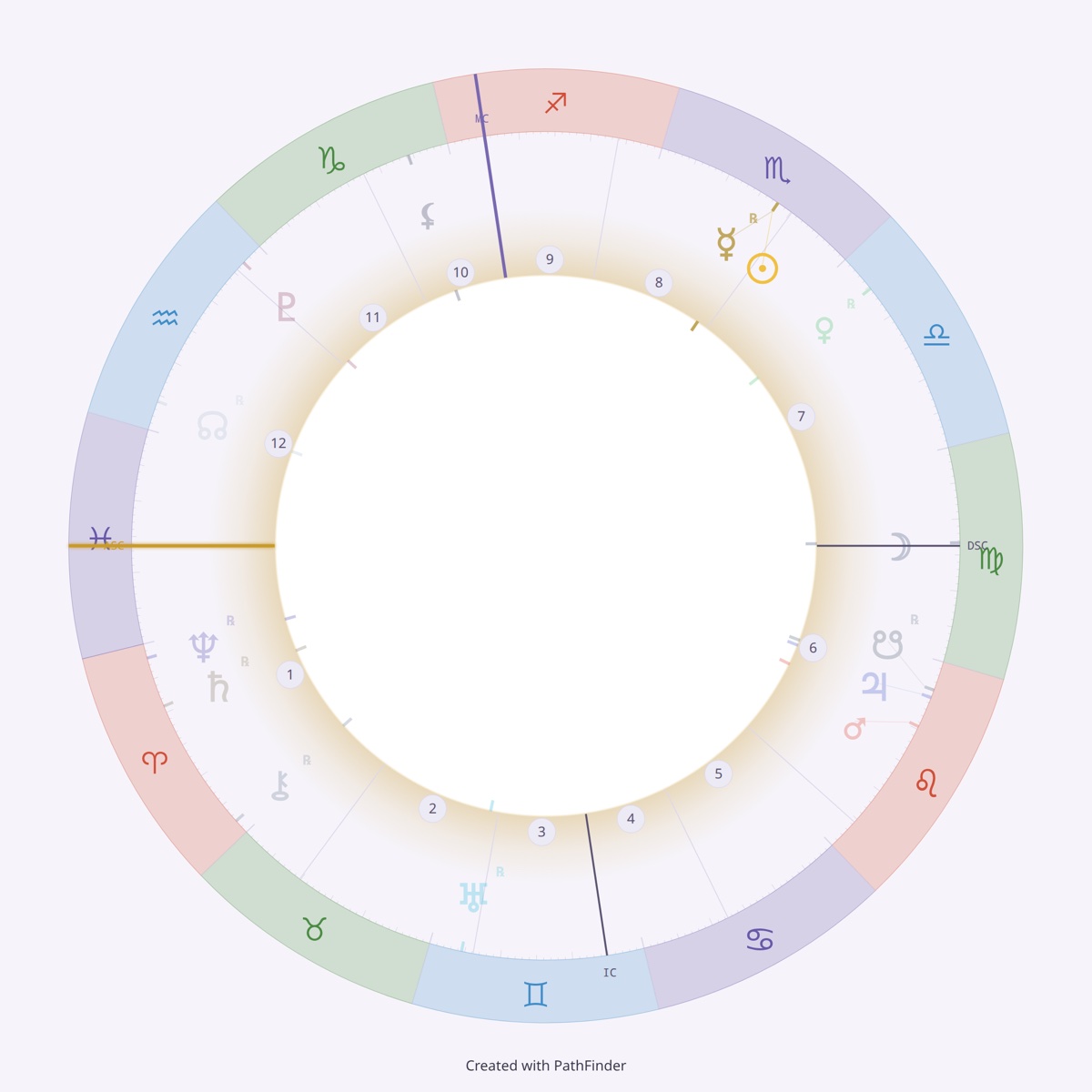
The sky version lasts hours. In a birth chart the same pair lasts a lifetime, so this week is a good moment to look at yours.
The only aspect these two can make
The Sun holds identity and will. Mercury holds thinking, speech and the way you make sense of things. Mercury never gets further than about 28° from the Sun, so the sextile, square, trine, opposition and quincunx are all impossible for this pair. That leaves the conjunction.
It is also common. We checked the sky across 1950 to 2010, and on about 1 day in 4 Mercury is within 8°30′ of the Sun, so about 1 person in 4 has it. With an aspect that common, the distance between the two planets tells you far more than the word “conjunct” does.
Closer is worse, until it flips
Traditional astrologers measured how close a planet stood to the Sun and gave each zone a name:
- Wider than 17°: free of the Sun’s beams, with no effect.
- Within 17°: under the beams, mildly hidden. More than half of all people, about 56%, have Mercury here or closer.
- Within 8°30′: combust, meaning burnt. Mercury is weakened and overpowered. About 1 person in 4.
- Within 17′: cazimi, “in the heart of the Sun.” The strongest position a planet can hold. About 1 person in 125.
The figures vary by author. William Lilly used 12° for the beams in his horary work, and older authors used 15°. We use the figures above.
So the closer to the Sun, the worse, until the last 17′, about a quarter of a degree. A planet that close counts as fortified, the opposite of burnt.
How combust Mercury tends to show up
Read these as tendencies; the rest of the chart sets the volume.
The modern reading is that identity and thinking have fused into one function. You think as you speak and speak as you are, so criticism of an idea is hard to hear as anything but criticism of you. In a meeting, someone questions your plan and you are defending yourself before you have considered whether they are right. You argue to protect yourself, and finding out what is true comes second.
The older reading looks different and describes the same problem. Traditional sources speak of a mind overpowered by the will, a fear of being seen, and trouble telling your own view from what the ego needs to be true. Chris Brennan connects much of Mercury’s old reputation for hiddenness and slyness to how often it goes under the beams.
Both pictures come from the same place in the sky. Mercury is hard to see when it stands near the Sun, and with this aspect the thinking can be hard for its owner to see too. Modern sources add strong opinions, and self-absorption toward the wide end of the range.
Cazimi: saying what everyone was thinking
Lilly and the sources after him describe unusual clarity and force of speech, ideas that land, and a voice that carries the whole person. Where combust Mercury argues to protect itself, cazimi Mercury says the thing everyone in the room was thinking.
This aspect attracts the word “genius.” That label is a cliché, and it confuses this placement with creativity. None of these conditions measure intelligence or mental health, at either end of the scale.
Morning star or evening star
Every Mercury near the Sun sits on one side of it, and the side changes the manner.
If Mercury is at an earlier degree than your Sun, it rose before the Sun on the day you were born. That is the morning star, called oriental: forward-leaning and quick to speak. If Mercury is at a later degree, it set after the Sun. That is the evening star, called occidental: reflective, speaking after it has thought.
A retrograde Mercury changes sides halfway through the meeting, which is what happens on Wednesday. Before the exact moment Mercury is at a later degree than the Sun, and afterwards it is at an earlier one, so the evening star turns into the morning star.
Born with Mercury retrograde conjunct the Sun
Retrograde changes the reading, because of where the meeting takes place. A direct Mercury meets the Sun on the far side of it. A retrograde Mercury meets it on the near side, passing between the Earth and the Sun. About 3 in 10 Sun and Mercury conjunctions are this version, which came to about 1 moment in 13 across 1950 to 2010. Your chart marks a retrograde planet with a small R beside it.
Three meanings hold in any sign:
- Retrograde at birth: thinking runs inward first, and going back over things is how it normally works. Kerykeion describes this as internalising, with no loss of strength.
- Conjunct the Sun: thinking and identity run as one signal, so an opinion can feel like the self.
- Between the Earth and the Sun: Astrology.com reads the retrograde meeting as the psychopomp, the guide of souls, with an unusual ability to see into what people keep hidden. It adds that this penetrating quality can put others off. Hexosophy calls the meeting tense and introspective, closer in feel to an opposition.
Without the cazimi
This is the usual version, with Mercury retrograde within 8°30′ of the Sun and outside the 17′ centre. As a tendency, those pieces add up to this. Your mind works inward and stays close to your sense of self. You go over things many times before anyone hears them, and you may pick up what people leave unsaid. Mercury is burnt here, so it can be hard to tell what you have concluded from what you need to be true. When someone challenges an idea it lands on you personally, and you may go quiet and carry on the argument inside. The work is to get a thought out early enough for someone else to test it.
With the cazimi
At the centre the burn turns into strength, as above, and the same inward mind gets the benefit. About 1 moment in 400 has this. Kerykeion, writing about the transit, reads a retrograde cazimi as clarity turned inward, on what needs to be revised or released, and a direct cazimi as looking outward and ahead. We carry that same difference into the birth chart.
The tendency changes with it. You still think in private and go back over things, and that going back is what brings a thought into focus. You tend to see plainly what needs to be revised or let go, often in your own life first. What you say comes out late with the whole person behind it, and people notice. A thought this close to you is hard to release unfinished, so the risk is that you keep it to yourself for too long.
In both versions the side of the Sun adds a shade. If Mercury is at a later degree than your Sun, it is on the evening side, which reads as the end of a thought, the summing up. If it is at an earlier degree, it is on the morning side, which reads as the first word of a new one. The names Epimethean and Promethean for these two sides come from Dane Rudhyar’s school.
In Scorpio, as on Wednesday
The sign tells you what the mind goes looking for. The placement on Wednesday adds two more layers to the cazimi version:
- Mercury in Scorpio: a mind that investigates, goes under the surface and is selective about what it says. Its shadow is suspicion and keeping things back.
- 12°10′ Scorpio: this degree falls in Mercury’s own bound, the small section of the sign assigned to it (11° to 19°), and that is Mercury’s only dignity in Scorpio. It also falls in the Sun’s decan (10° to 20°), a further tie between the two.
About 1 moment in 5,300 has a retrograde Mercury cazimi in Scorpio, and it tends to read like this. You think in private first. Your mind goes straight to what sits under the surface of a conversation, then goes back over what it found until it holds up. With Mercury this deep in the Sun, your thinking and your sense of who you are work as one signal, so what you finally say tends to come from something you have already looked at honestly. People can feel that weight, and it can unsettle them. The same gift turned around means holding everything back until it is perfect, or hearing a challenge to your idea as a challenge to you.
We found no source that describes these exact combinations, so the assembled readings are ours. A child born on Wednesday between 12:27 and 18:21 Amsterdam time has the Scorpio version by longitude.
Same sign or different sign
When the Sun and Mercury share a sign, thinking and persona agree, and combustion is likely. When a wide conjunction crosses a sign boundary, astrologers call it dissociate, and the way you come across in words can differ from who you are. Sun at 28° Libra with Mercury at 2° Scorpio is only 4° apart, and the signs still differ.
The exception: Mercury in its chariot
Antiochus and Porphyry describe a protection. A planet under the beams in its own domicile, exaltation or triplicity is safe, as if riding in a chariot. For Mercury that means Gemini and Virgo. The Dorothean triplicity table adds the air signs by night, so Mercury in Libra or Aquarius gets the same cover in a night chart. John Frawley reads Mercury combust in Gemini as hidden but unharmed.
How we read it
We apply no combustion penalty when we rank the planets in a chart. A combust Mercury sits on the Sun, and that is what makes it dominant. Cazimi is the strongest position of all. Combustion tells you how Mercury acts, and its rank stays where it is.
“Sun conjunct Mercury” and “Mercury combust” are one fact said twice, so we count it once.
The sky this month
The whole passage, in Amsterdam time:
- 26 October, 23:00: Mercury goes under the beams.
- 31 October, 20:14: Mercury turns combust.
- 4 November, 12:27: the cazimi window opens.
- 4 November, 15:24: exact conjunction at 12°10′ Scorpio.
- 4 November, 18:21: the cazimi window closes.
- 8 November, 12:47: combustion ends.
- 14 November, 12:11: Mercury leaves the beams.
Mercury stands 0°22′ south of the Sun’s path at the conjunction, and the stricter test used by Bonatti and Coley also counts that distance. By that test Mercury is not cazimi on Wednesday, so we call it cazimi by longitude.
Chris Brennan gives a useful way to read a retrograde: it is set up at the first station, turns at the cazimi and resolves at the second station. This time that means 24 October at 20°59′ Scorpio, 4 November, and 13 November at 5°02′ Scorpio. If something reopened around 24 October, Wednesday is when to look at it again.
You are most likely to notice it if you have the Sun, Mercury or an angle near 12° Scorpio, or if you were born with this aspect, since the sky is repeating it. If your Sun is between about 12°03′ and 12°18′ Scorpio, your 2026 solar return has Mercury cazimi by longitude.
How to check if you have it
Find the Sun and Mercury in your birth chart and work out the distance between them. Within about 8° is a conjunction by the usual standard, which is nearly the same limit as combustion. Then ask three things. Which zone of the scale does the distance fall in? Is Mercury at an earlier or later degree than the Sun? Are they in the same sign? After that, Mercury’s sign tells you whether the chariot applies, and the house tells you where in life you will see it.
A birth time is not needed for most of this. Mercury moves slowly enough that the date alone usually settles the question, unless you are close to the edge of a zone.
So, how long does it take?
The gift of this aspect is a voice with a whole person behind it, and the work is learning that an idea can be wrong while you stay fine. The cazimi window on Wednesday lasts about six hours, and your natal distance stays. When someone disagrees with your idea, how long before it feels like they disagree with you?
Sources. The 4 November 2026 positions, times and latitude, the share of dates in each zone, and the retrograde and Scorpio shares (1950 to 2010), were computed with the Swiss Ephemeris, tropical zodiac. The chart wheel is rendered by the PathFinder renderer for Rotterdam, 4 November 2026 at 15:24, Placidus houses, with nothing drawn on top of it. The natal material draws on PathFinder’s research notes, William Lilly, Guido Bonatti, Henry Coley, Antiochus and Porphyry as summarised in reference sources, John Frawley, The Astrology Podcast with Chris Brennan, Dane Rudhyar as summarised in reference sources, and reference material from Skyscript, Kerykeion, Astrolibrary, Astrotheme, Astrology.com and Hexosophy. For personal reflection and educational purposes.