Moon Opposite Saturn: The Natal Aspect and the 10 October 2026 Sky
Do you find it hard to ask for help?
Do you hold things together for everyone else and only feel the weight once the room is empty?
Or is it the other way round? Maybe you are the steady one and keep choosing people who need looking after, or other people tend to feel cold to you, withholding just when you need them.
Tomorrow the sky draws the shape of that feeling for a few hours. The transiting Moon opposes Saturn exactly on 10 October 2026 at 03:53 UT, which is 05:53 in Amsterdam. The Moon stands at 10°52′ Libra and Saturn at 10°52′ Aries, retrograde. The Sun is close by at about 16°52′ Libra, so it is opposite Saturn too, at roughly a 6° orb and separating. The Moon is in its balsamic phase, the dark Moon just before the Libra New Moon, which follows within the day.
The signs add a twist. Saturn in Aries is in its fall, the sign where it is traditionally weakest. The Moon in Libra stands in Saturn’s exaltation sign, where Saturn is at its best. Traditional astrologers call that reception: the planet pressing on the Moon also favours the sign the Moon is in. The Sun has the same mirror this month, each in the other’s best sign.
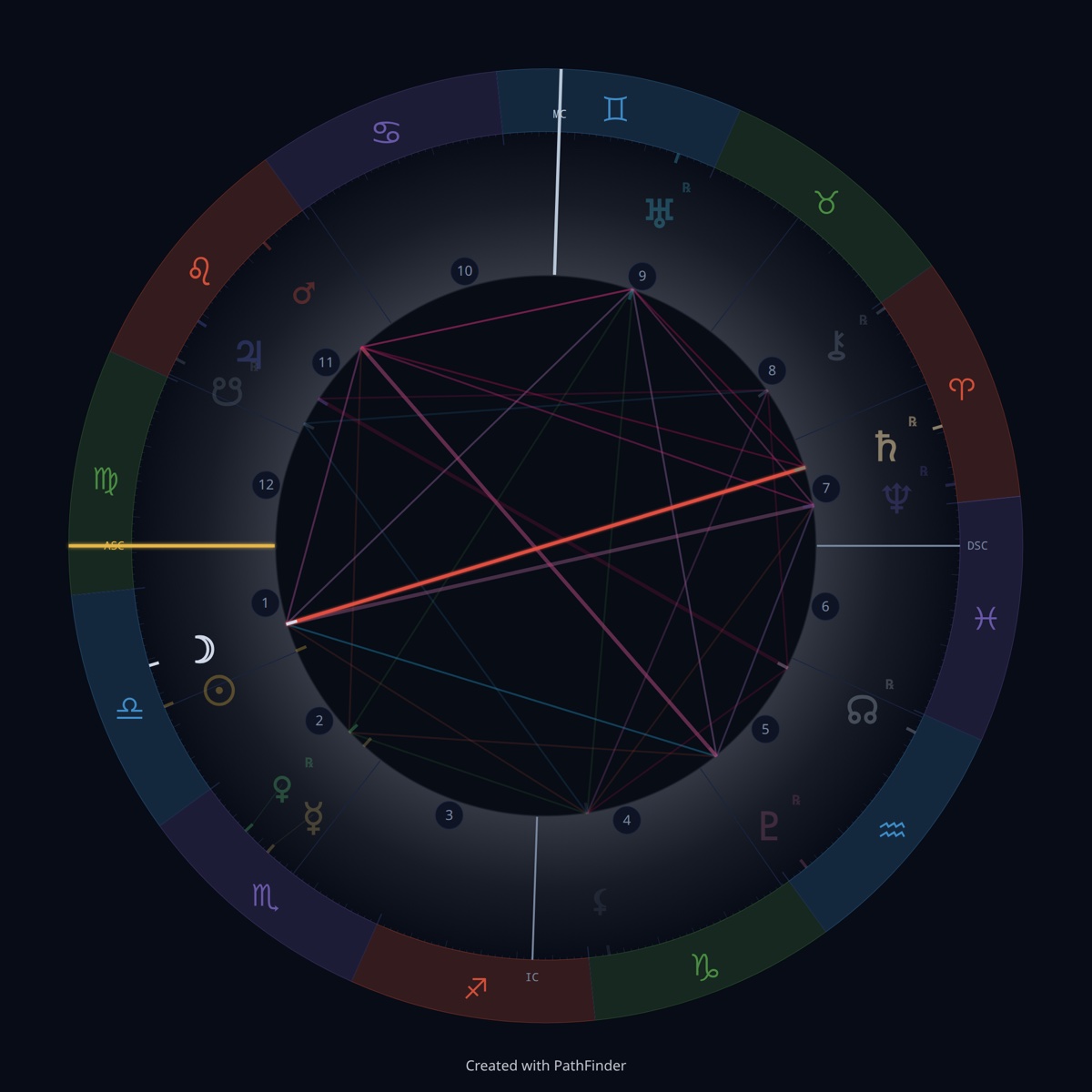
A Moon pass lasts a few hours, but it makes tomorrow a good night to look at the same pair in a birth chart, where it lasts a lifetime.
The two planets, and why the opposition is its own thing
The Moon holds our needs: safety, the body, mood, the caretaker, home. Saturn holds limits such as duty, time, scarcity, authority and the habit of relying on yourself. Put them together and you get the question of how care and duty share one life.
The angle changes the answer. In a conjunction the two are fused, felt from the inside as one knot. In a square they grind, and the friction pushes toward action. In an opposition they sit across the chart from each other, and the person tends to live it as a pull between two poles, often meeting one of them first in other people.
How it tends to show up
Read these as tendencies; the rest of the chart sets the volume. Four of them get their own section further down.
- The early emotional climate. Care felt conditional, rationed or earned, and the child became self-sufficient early. More under Responsible too young.
- Need against duty. A swing between wanting to be held and insisting you need nobody. More under Why you find it hard to ask for help.
- Projection. The opposition’s signature: the cold, withholding one is met in a partner, a boss or an institution, or you become the parent to the people you love. More under The partner as your Saturn.
- Mood. There can be a predisposition toward low moods, worry, and seasonal or long-running heaviness. Chris Brennan (episode 294) stresses that a chart shows a predisposition, not a destiny.
- Home and body. A sense of home often comes late or takes effort, and family responsibility arrives young. Traditionally Saturn rules the bones, teeth, joints and skin, and the qualities of cold and dryness. Read that as symbolism; nobody is diagnosing you.
- The gift. Emotional reliability, and the capacity to build lasting security for yourself and others. More in the closing.
Why you find it hard to ask for help
For many people with this aspect, asking is the hardest sentence. Underneath it sits an old calculation, learned early: needing something costs someone else, so the safe move is to need less.
So the need goes underground and comes back as tiredness, or as irritation with people who ask easily. Offered help gets turned down politely, then resented a little when the offers stop.
Because both poles are in you, the opposition gives a way in. Saturn says “I can manage,” and the Moon would like not to have to. We suggest letting the Moon speak first now and then, in small and low-stakes ways: one practical favour, asked plainly, with no apology attached. Saturn can then do what it does well and notice that the sky did not fall.
The partner as your Saturn
Oppositions are often lived through relationship. With this one, a partner can come to carry the Saturn end and seem cold, critical or unavailable, holding back the warmth you need. Often an old picture has been laid over a new person, and the partner is answering a question they were never asked.
In the other version you carry Saturn yourself and choose partners who need parenting. It feels like love and also like work, and it keeps your own need out of view.
Both versions are the same split, worked out in two bodies. A guest on The Astrology Podcast (episode 532), with this natal opposition in a night chart, described a partner who was the steady one through their hard periods. So the right partner can supply what the chart seemed to withhold, and steadiness offered without conditions can teach the Moon that care does not have to be earned. Ask yourself which role you keep taking, and whether you picked it or inherited it.
Parenting yourself, and the Saturn return
This aspect tends to ripen with age, on Saturn’s own clock, and here the clock has a twist: because natal Saturn sits opposite the natal Moon, any time transiting Saturn reaches one end of the axis it is also aspecting the other.
Around 14 or 15, transiting Saturn opposes its own birth place, which puts it right on the natal Moon. Adolescent heaviness often lands then.
Around 29, transiting Saturn returns to where it stood at birth, the first Saturn return. With this aspect it is also transiting Saturn opposite the natal Moon, which is why it so often marks the turn. People stop waiting for the caretaker they did not get and start becoming that caretaker for themselves, with regular meals, rest that is scheduled and kept, and a home that feels like theirs.
The cycle repeats. Around 44, transiting Saturn crosses the natal Moon again. Around 58 or 59 comes the second Saturn return, once more opposite the Moon. By then many people describe the inner critic as quieter, more like an ally.
Responsible too young
A common story with this aspect is the child who became an adult early: the eldest who raised siblings, or the one who translated for parents, kept the household running through an illness, or learned to read the mood of the room before walking in. Liz Greene’s work on Saturn and the dutiful child comes close to this.
That child became competent, and competence was rewarded, so it stuck. In adulthood it can look like over-functioning, being the grown-up in every room and uneasy when nobody needs you.
The skills are real and can stay; the difference is that you now choose them. One useful exercise is to name, specifically, what the younger you missed, like being looked after when ill, being allowed to be loud, or being told there was enough. Those are often worth giving yourself now.
This aspect does not mean a bad mother or a bad childhood. More often it describes a caretaker who was stretched thin, and a child who noticed.
Night chart or day chart: the same aspect, two weights
Hellenistic astrology adds a factor that changes the reading a great deal: sect. A chart is a day chart if the Sun was above the horizon at birth, and a night chart if it was below.
In a night chart the Moon is the sect light, and Saturn is the out-of-sect malefic, the one traditional authors expect to work less kindly. So they expect an opposition between the two to weigh more.
In a day chart Saturn is in sect and tends to be more constructive, closer to structure and patience than to cold.
If you know your birth time, this is one of the first things worth checking.
When it gets switched on
Transiting Saturn crossing the natal Moon is the big one. Vedic astrology has a name for the longer stretch around it: Sade Sati, Saturn’s roughly seven-and-a-half-year passage through the sign before the natal Moon, the Moon’s own sign and the sign after, counted in the sidereal zodiac. Saturn on the Moon is its middle. The progressed Moon crossing the Moon–Saturn axis brings the theme forward for a few months, and lunar returns show how each month sets it up.
The monthly Moon pass, like tomorrow’s with the Sun also opposite Saturn, is only a small echo of the natal pattern.
How to check if you have it
Look at the Moon and Saturn in your birth chart. If they are within about 8° of exactly opposite, you have the aspect; many astrologers allow up to 10° for the Moon. Traditional whole-sign practice also counts a Moon and Saturn in opposite signs as in aspect, more loosely, even when the degrees are further apart.
The Moon moves about 13° a day, so it spends only a day or two each month opposite Saturn, which still leaves plenty of people born in that window.
What changes the reading
We never read one aspect alone. Before deciding how much this one matters, check:
- Sect. A night chart is traditionally heavier. In a day chart Saturn tends to be more constructive.
- Dignity. A Moon in Cancer or Taurus, or a Saturn in Capricorn, Aquarius or Libra, steadies the aspect. A Moon in Capricorn or Scorpio, or a Saturn in Cancer, Leo or Aries, makes it harder going.
- Sign pairs. The natal pair can sit on any axis, and each one has its own flavour. Moon in Cancer opposite Saturn in Capricorn sets home against career. Moon in Leo opposite Saturn in Aquarius sets being seen against standing apart. Moon in Taurus opposite Saturn in Scorpio sets comfort against control.
- Houses and rulership. The houses name the arena: across the 4th and 10th, home against career; across the 1st and 7th, self against partner; across the 2nd and 8th, your own security against shared money and resources; across the 6th and 12th, work and health against withdrawal and retreat. Saturn’s house is often where the cold is felt. If the Moon rules the Ascendant, the aspect moves to the centre of the whole story.
- Help from the benefics. A Venus or Jupiter aspect to either end softens it.
- Orb and direction. A tight, applying opposition is more pronounced than a wide, separating one.
So, which pole do you lean on?
This aspect has its gift too: these are the people everyone leans on in a crisis, who build lasting security and, once they soften, care deeply for whoever is vulnerable. Tomorrow’s pass is over by breakfast, but the natal aspect, if you have it, stays. Is your chart a day chart or a night chart, which houses hold your Moon and Saturn, and who in your life is currently carrying your Saturn for you?
Sources. The 10 October 2026 positions and time were computed with the Swiss Ephemeris, tropical zodiac. The chart wheel is rendered by the PathFinder renderer for Rotterdam, 10 October 2026 at 05:53, Placidus houses, with nothing drawn on top of it. The natal material draws on PathFinder’s research notes, The Astrology Podcast with Chris Brennan (episode 532, a guest’s life story; episode 294 on predisposition; episode 135 on Sade Sati), the dutiful-child theme in Liz Greene’s work on Saturn, and paraphrased reference material on Moon–Saturn aspects. For personal reflection and educational purposes.